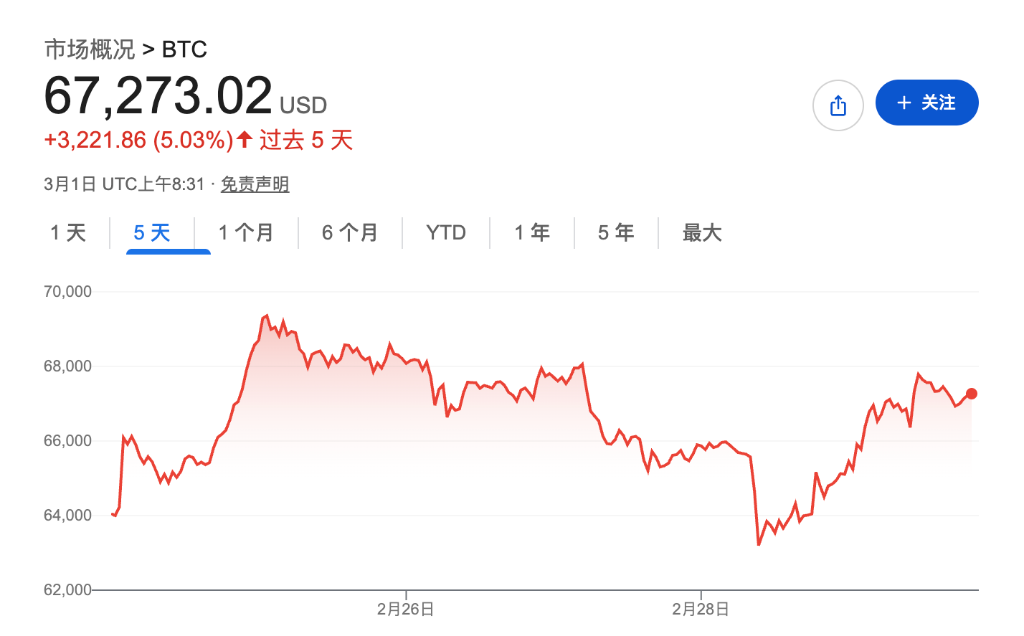
Bitcoin's V-shaped reversal following the sharp escalation of tensions in the Middle East is being interpreted by some market participants as a positive signal for the opening of global risk assets on Monday.
Academy Securities strategist Peter Tchir stated in a report that, as the only tradable risk asset over the weekend, Bitcoin has historically been a barometer of market sentiment, and its rebound suggests that risk appetite is recovering. Meanwhile, oil prices have already partially priced in some geopolitical risks, providing further support for markets to open in a risk-on mode on Monday.
As the U.S.-Iran situation evolved, Bitcoin experienced a reversal from a "sharp decline" to a "significant rally." Following news of Israel's airstrike on Iran, digital assets plummeted sharply, but as Iranian state media confirmed the death of Khamenei, the market quickly reversed and surged. Bitcoin not only recovered its losses but also rose above the levels seen before the conflict erupted.
According to a CCTV News broadcast, Iran's Supreme Leader Khamenei was killed in an attack on the morning of February 28. Israel claimed that Khamenei and his senior aides, including Ali Shamkhani, Secretary of Iran's Defense Committee, and Mohammad Pakpour, Commander of the Islamic Revolutionary Guard Corps, were killed in the airstrike.
In the report, Tchir expressed optimism that markets would open in a "risk-on" mode on Monday. He noted that oil prices had risen from around $60 per barrel at the end of last year to $72 per barrel last Friday, indicating that some conflict risk premiums had already been priced in by the market. Additionally, with Iran's leadership severely weakened, the logic of its strategic calculations has been disrupted—"now it's time to seek a dignified exit."
Bitcoin's Role as a "Barometer"
The report stated that this is the third time in recent years that Bitcoin has acted as a real-time barometer of market sentiment during a major Middle East conflict over the weekend. Each time, the initial reaction was a sharp decline, but this time, the strength of the rebound was entirely different.
On April 13, 2024, when Iran launched a large number of suicide drones at Israel, the conflict also occurred early Saturday morning while global markets were closed. Bitcoin's initial reaction at the time was a sharp decline.
On June 21-22, 2025, "Operation Midnight Hammer" used B-2 bombers carrying massive bunker-buster bombs to destroy three nuclear facilities at Fordow, Natanz, and Isfahan. The timing once again fell on a Saturday morning, and Bitcoin again experienced a knee-jerk decline.
The key difference this conflict compared to the previous two is that Bitcoin achieved a significant rebound after the sharp decline, with its final price higher than the pre-event level. In the report, Tchir interpreted this price action as a "risk-on" signal.
Oil Prices Have Partially Priced in Conflict Risks
The energy market is a core variable for measuring the macroeconomic impact of this conflict. Academy Securities strategist Peter Tchir outlined multiple factors influencing oil prices in the report:
First, risks have been partially priced in. Brent crude has risen from around $60 per barrel at the end of last year to $72 per barrel last Friday. This increase reflects both U.S. winter energy demand and a certain degree of conflict risk premium. This means that a significant portion of the potential "bad news" for oil prices has already been anticipated ahead of Monday's opening.
Second, supply channels remain unimpeded for now. Tchir pointed out that there are currently no signs of the Strait of Hormuz or other key oil transportation channels being blocked. He stated: If there is an opportunity to de-escalate without affecting channel transit, this is the core premise for oil prices remaining contained.
Finally, buffer inventories provide a safety cushion. Major global oil-consuming nations have ample crude reserves, and U.S. inventory levels are also relatively high. Therefore, short-term supply disruptions of about a week are expected to have limited impact. Based on this assessment, Tchir expects near-term contracts could test $80 but does not anticipate significant volatility in the forward curve.